The Wellness Stack: Where the Toothbrush Fits
Walk through any well-designed bathroom in 2026 and you are looking at a wellness stack. The objects are real, the choices are personal, and almost none of them are accidental.
There is, on the counter, a serum. Probably two. There is an exfoliant somewhere. There is a body lotion with a serious label. There is, near the shower, a dry brush. There might be a red-light device. There might be a small mouth-taping product. There is, certainly, a candle.
This is the modern American bathroom of a person who has been paying attention. None of these objects were on most counters fifteen years ago. All of them are on a lot of counters now.
The wellness stack is real. People have, slowly, layer by layer, built a daily practice around the bathroom. They get up. They wash. They apply. They massage. They light something. They drink something. They take a moment.
The strange thing, when you look closely, is that almost nobody has added the toothbrush to that stack.
The blind spot
Brushing your teeth is, technically, a wellness behavior. It improves your health. It is performed twice daily. It involves a tool, a paste, a glass of water, a small set of motions, a clear beginning and end. By any structural definition, it should be part of the morning and evening rituals everyone has been carefully curating.
But it is not. It is the thing you do on autopilot, on the way out of the bathroom, while you are already half-thinking about something else. The tool is purchased at the drugstore in thirty seconds, off a shelf of identical SKUs, with no consideration. The paste is whatever was on sale. The whole act is performed adjacent to the wellness routine, not as part of it.
I have a theory about why. The wellness category, broadly, has emerged from spaces that already had aesthetic capital. Skincare came out of beauty, which is a visual industry. Supplements came out of athletics and high-end nutrition, both of which are aspirational categories. Sleep came out of bedroom design and meditation, which already had quiet design language.
Dental care, by contrast, came out of a clinical, drugstore, mass-market lineage. The aesthetic capital is zero. The packaging is loud. The brands speak in claims rather than in tone. The whole category sits outside the wellness conversation because nothing about its presentation invites you in.
This is, I think, the gap.
What the stack actually does
The reason people build a wellness stack is not because each individual product is life-changing. Most of them are not. The reason is that the practice of selecting, arranging, and using a small number of well-chosen objects in a daily routine is, itself, a kind of self-respect.
You are saying, with the act of laying out the serum and the body brush and the candle, that the morning is a thing worth attending to. That you are a person worth attending to. That the bathroom is not just a utility room but a small private space where you take small private care of the body you live in.
A wellness stack is, at its most honest, a daily declaration that you matter. The serum is the medium. The declaration is the thing.
This is why a bad object in the stack is jarring. A beautiful skincare line on a marble counter, next to a plastic toothbrush with a screaming logo, feels wrong. The toothbrush is interrupting the sentence. The declaration falters.
Where the toothbrush should sit
If you were going to add the toothbrush to your wellness stack, it would sit somewhere between the skincare and the supplements. Personal-care category. Daily use. Functional. Tool-shaped. Touches the body.
The other tools in that part of the stack already got their design upgrade. The face roller is jade, in a wooden cradle. The tongue scraper is copper, in a small pouch. The body brush has a natural bristle and a wooden handle. The makeup brushes are kept in a brass cup. Each of those tools sits where it belongs because each of them is, in its category, beautiful enough to belong.
The toothbrush is the only tool in that section of the stack that has not been redesigned. The only one that still arrives in plastic, that still comes in a blister pack, that still looks like it was made for a 1990s drugstore aisle.
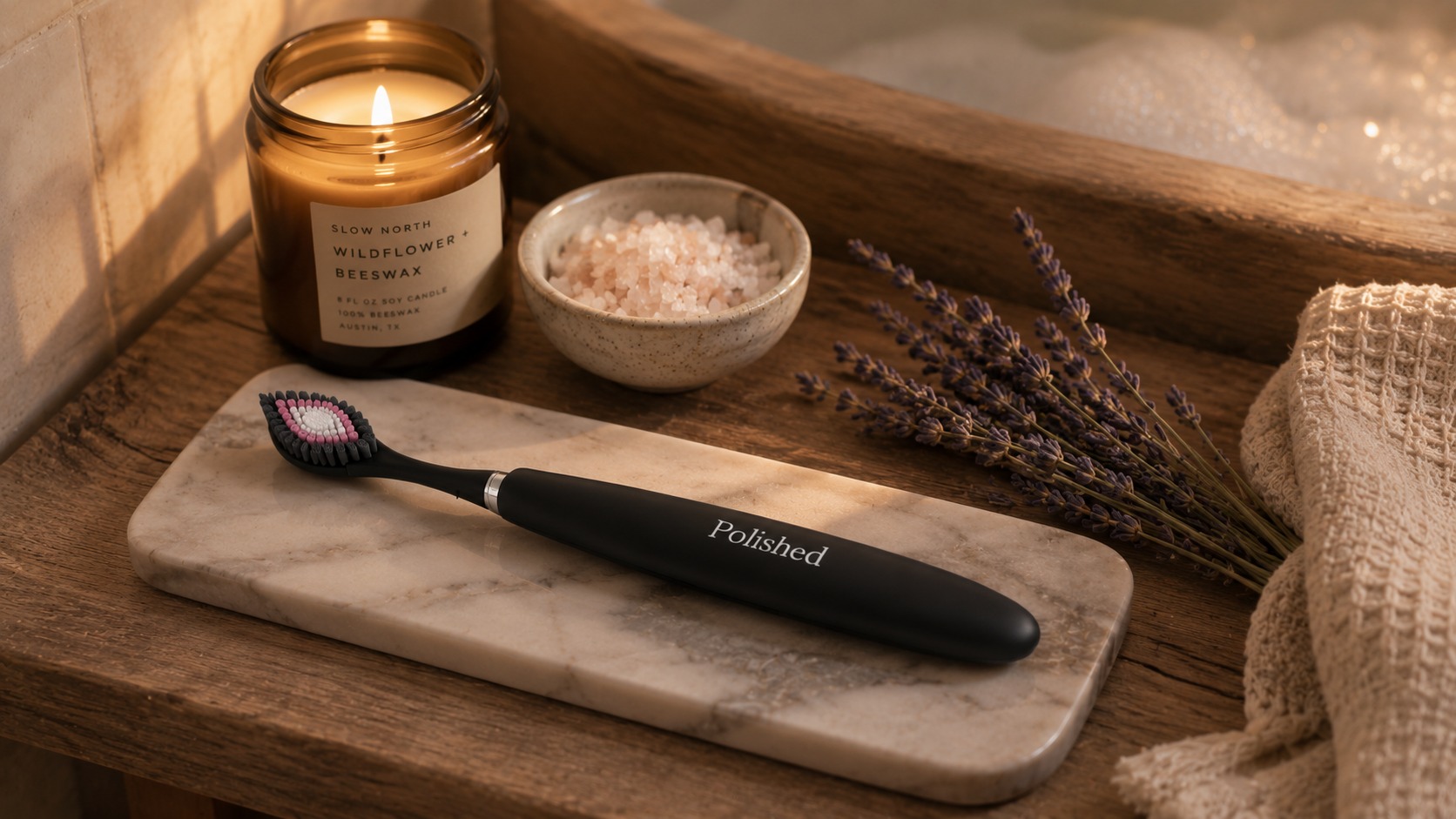
This is the gap Polished is trying to fill. We are not asking you to add a new wellness behavior to your morning. You already do this one. We are asking you to upgrade the object you are doing it with, so that the wellness stack can finally include the most-repeated wellness behavior of your life.
What changes when you do it
A small thing changes when you upgrade the toothbrush to a wellness-grade object.
You start brushing slower. You stop racing through it on the way to the door. The two minutes becomes part of the ritual, the way the face roller is part of the ritual, the way the candle being lit is part of the ritual. The whole bathroom slows down by a quarter.
You start putting the brush out, on the shelf, the way you put out the other tools. The plastic cup gets retired. A small ceramic dish takes its place. The brush stands up in the dish the way the makeup brushes stand up in the brass cup. It looks intentional. It is intentional.
You start noticing the small choices you make about the brush itself. The color. The angle of the head. The weight in the hand. You did not used to notice these things because the object was beneath notice. Now it is in the stack. It earns the attention.
This is what we mean by a wellness stack. It is not a list of products. It is a set of objects that have earned their place by being beautiful enough to be present.
What we are trying to add
Polished is not, to be clear, a wellness brand. We are not making health claims. We are not promising clinical outcomes beyond what brushing your teeth normally accomplishes.
We are trying to add a beautifully designed dental object to the shelf where the beautifully designed skincare and supplement and ritual objects already live. So that the wellness stack, the one you have been carefully building for years, can finally have its last missing piece.
If you have built the rest of the stack already, you know exactly what I mean. You have been looking at the toothbrush, every morning, knowing it does not belong with the rest of the room, and not knowing what to replace it with.
We hope to be the replacement. Eventually, on every shelf where the candle and the serum already live.
Richard