The Cup on the Counter
Every bathroom has one, and almost nobody has ever chosen it on purpose.
The toothbrush cup. Sometimes it is an actual cup, a leftover from a kitchen set that lost its siblings. Sometimes a plastic holder that came free with something. Sometimes just the edge of the sink, where the brush lies on its side collecting whatever the sink collects. It is the least considered object in the least considered corner of an otherwise designed home.
September on the journal has been about ritual, and this week I want to spend a few minutes on the stage where the ritual actually happens. Because you cannot upgrade the two minutes of brushing without upgrading the four inches of counter where the brush lives the other twenty three hours and fifty eight minutes of the day.
An object is only as good as its resting place
Here is a design truth that took me too long to learn. Nobody experiences an object in isolation. You experience it in context, at rest, in the setting where it spends most of its life.
A beautiful knife in a cluttered drawer reads as clutter. The same knife on a magnetic strip reads as a tool worth owning. Nothing about the knife changed. Its resting place did the talking.
The toothbrush has spent a hundred years resting badly. Face down on porcelain, jammed in a plastic slot with three others, or standing in a cup so generic it disappears. Which is fine, honestly, if the brush is also generic. Ugly things do not deserve pedestals. But the moment the object improves, the resting place has to catch up, or the improvement never registers.
Designing for the standing position
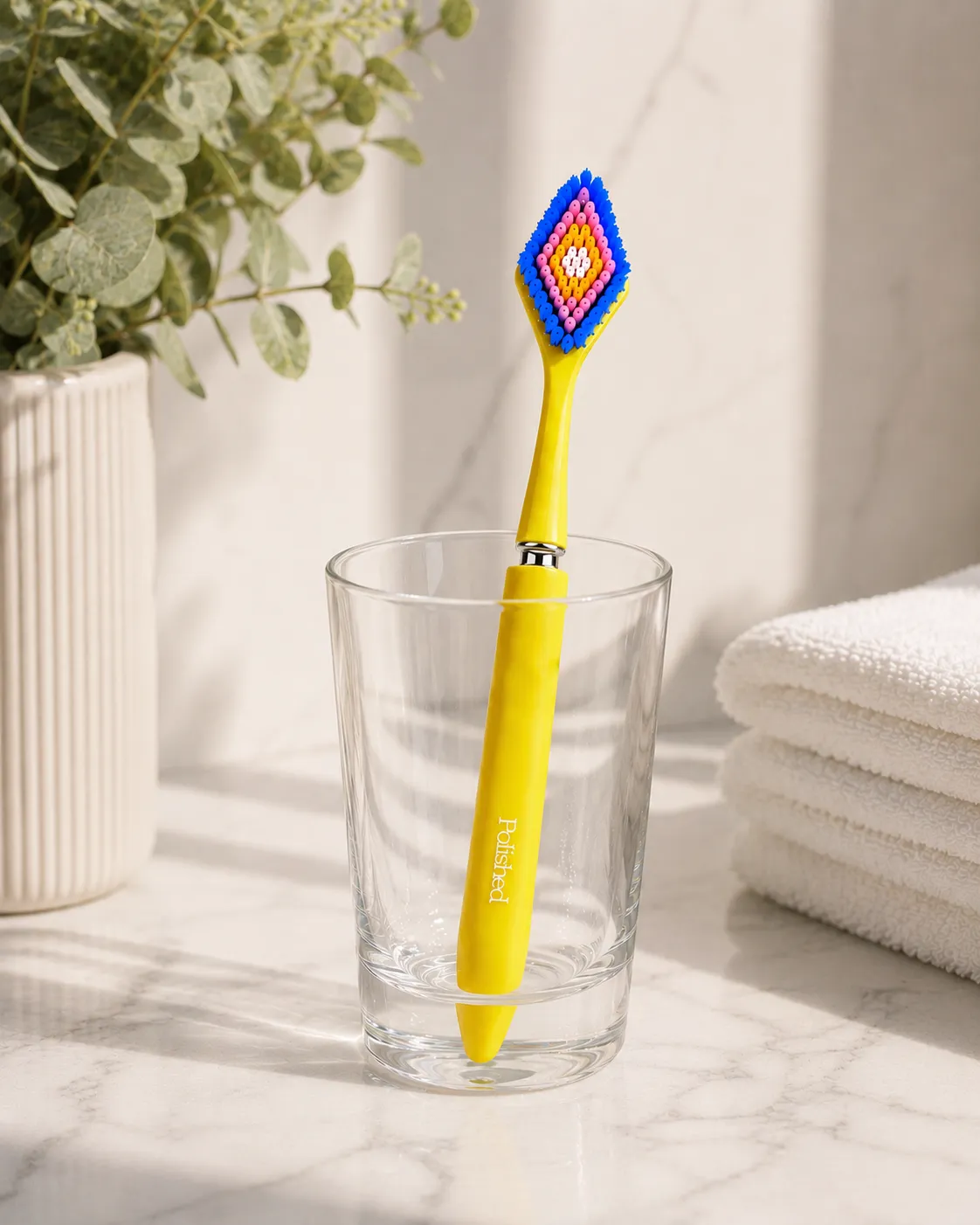
When we designed Polished, we spent almost as long on how it stands as on how it brushes. The handle has a slight weight toward the base. The charcoal reads as matte and calm from across a room. The diamond head, with its soft white disc at the center, was drawn to be seen from above and from the side, because those are the two angles from which you look at a toothbrush that lives upright in a glass.
Every color, the master charcoal and the seven accents, was tested standing in a clear glass on a white counter, because that is where we hoped it would end up. In a glass. Visible. Chosen.
That is not vanity. That is the whole thesis of the brand in one gesture. A toothbrush good enough to leave out is a toothbrush that changes how the counter feels, and the counter is where the morning starts.
The cup audit
So here is the exercise, and it takes about a minute.
Look at whatever your toothbrush is standing in right now. Ask two questions. Did I choose this? Would I photograph it?
If the answer to both is no, you have found the cheapest, fastest upgrade in your entire bathroom. A clear glass tumbler. A small ceramic cup you actually like. Something with weight, something that catches light, something that would look right holding a single stem of eucalyptus if it were not holding a toothbrush.
Then put the brush in it and step back. Notice how the corner changes. Notice, if the brush is a plastic stick from the aisle, that the nice glass now makes it look worse, not better, because the glass is telling the truth about its contents.
That gap, between the cup you deserve and the brush inside it, is where Polished lives.
The other twenty three hours
The two minutes of brushing matter. We have written about them all month. But the ritual is bigger than the act. It includes the moment you reach for the brush and the moment you set it back down, and it includes every glance at the counter in between, all day, on your way past.
An object at rest is still doing its job. Give it somewhere to do it well.
Brush. Beautifully. Then stand it somewhere worthy of the sentence.